
More than workload
Understanding burnout means looking beyond how much someone is doing.
Factors such as constant pressure, unclear expectations, poor communication, lack of support, feeling undervalued, or having little opportunity to recover can all contribute to burnout over time.
Understanding burnout means looking beyond how much someone is doing and considering the environment they are doing it in.
Stress
Most people experience stress from time to time. Stress is often linked to a specific challenge, deadline, or difficult period and may ease once the pressure reduces.
Burnout
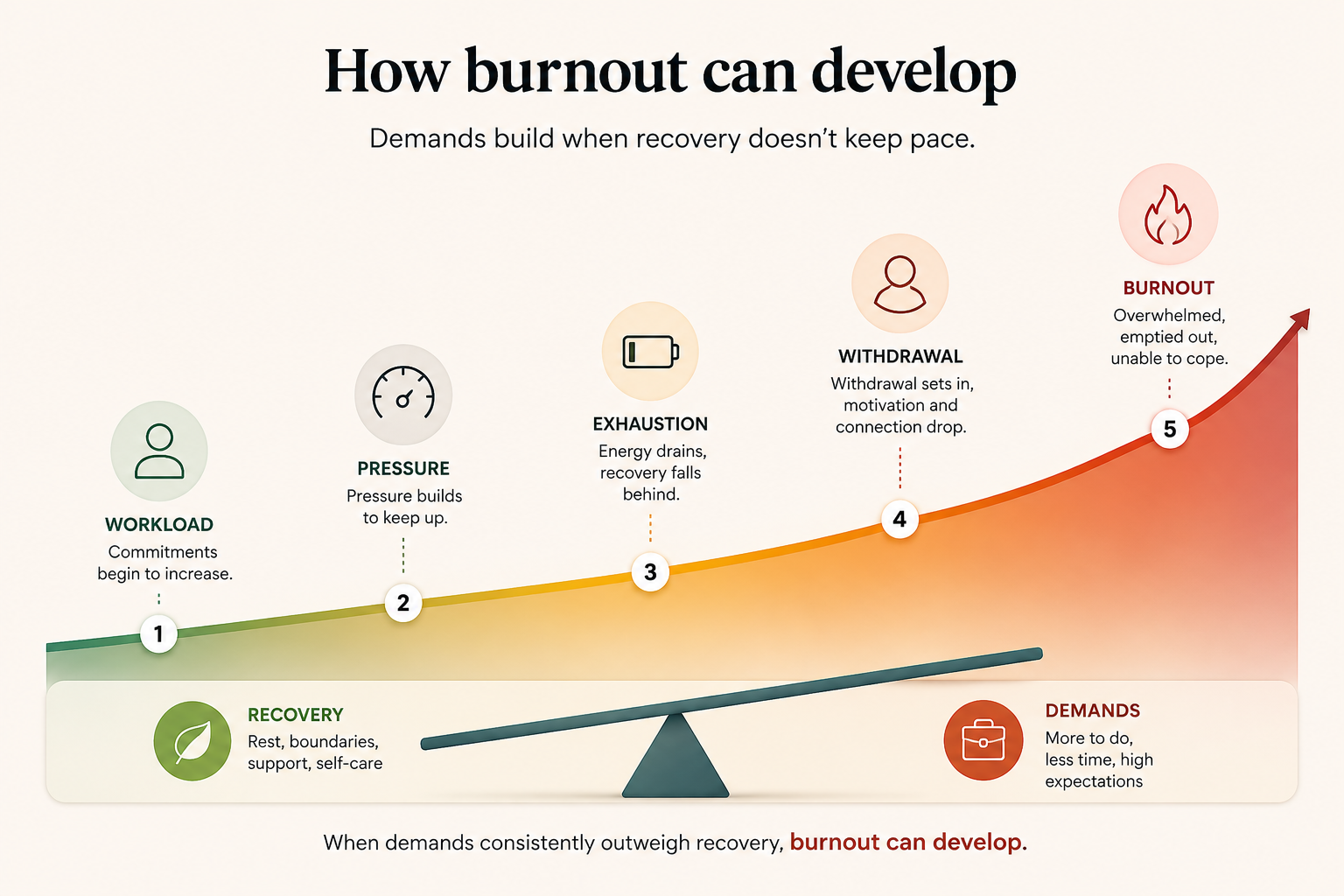
Burnout can develop when pressure becomes persistent and recovery becomes increasingly difficult.
Burnout Is More Than Stress
Burnout is different.
Rather than feeling stretched by a particular situation, a person may begin to feel emotionally exhausted, mentally drained, or detached from responsibilities that once felt manageable.
People often describe feeling as though they are running on empty. Motivation may begin to decline, concentration can become more difficult, and even small tasks may require significantly more effort than they once did.
For some, burnout can also affect sleep, relationships, confidence, and overall wellbeing. What began as stress can gradually become a sense of depletion that rest alone does not immediately resolve.
The environment matters
Burnout is not simply the result of working too hard.
One of the biggest misconceptions about burnout is that it is simply the result of working too hard.
While workload can certainly play a role, burnout is often influenced by a much wider range of factors.
Poor communication, unclear expectations, constant pressure, lack of recognition, limited support, and ongoing change can all contribute to burnout over time.
When people feel valued, supported, and clear about what is expected of them, they are often better able to manage periods of pressure. When those conditions are missing, even highly capable people can begin to feel exhausted, overwhelmed, and disconnected.
This is one reason burnout can be difficult to recognise. People often assume the problem lies with them, when in reality the environment they are working within may also be playing an important role.
Burnout is not always a reflection of the individual. Sometimes it reflects the conditions they have been trying to function within for an extended period of time.
What People Often Notice First
Burnout does not always arrive suddenly.
For many people, it develops gradually. What begins as tiredness, frustration, or feeling under pressure can slowly become something more persistent.
People often describe feeling emotionally exhausted, finding it harder to concentrate, or struggling to engage with work in the way they once did.
Tasks that previously felt straightforward may begin to feel overwhelming, and motivation can start to decline.
Some people notice they have become more withdrawn. Others find themselves feeling irritable, detached, or increasingly cynical about responsibilities they previously cared about.
Burnout can also affect life outside of work. Relationships, sleep, confidence, and overall wellbeing may all be impacted.
Because these changes often happen gradually, people do not always recognise burnout immediately. Instead, they may simply feel that they are not functioning like themselves.
Can People Recover?
Recovery from burnout is possible, although it often takes more than a few days off or a short break.
For many people, recovery involves understanding what contributed to the burnout in the first place. This may include looking at workload, expectations, boundaries, support systems, workplace culture, or other pressures that have built up over time.
Rest is often an important part of recovery, but sustainable change can be equally important. Without addressing the factors that contributed to burnout, people can find themselves returning to the same cycle.
Recovery looks different for everyone, and it is rarely a race. For many people, it is a gradual process of rebuilding energy, confidence, and balance over time.
A different question
"What has been happening that has left me feeling this way?"
A Different Way of Looking at Burnout
Burnout is often spoken about as though it is a personal failing, a sign that someone is not coping well enough or should simply try harder.
In reality, burnout is usually far more complex than that.
It often develops when demands consistently outweigh a person's ability to recover. Workload may be part of the picture, but so can uncertainty, lack of support, poor communication, limited control, or feeling undervalued for a prolonged period of time.
Rather than asking, "Why can't I cope?", it can be more helpful to ask, "What has been happening that has left me feeling this way?"
Burnout is not a sign of weakness. It is often a sign that something important has been out of balance for too long.
Understanding what contributed to burnout can be an important first step towards recovery and moving forward.
Browse Therapists
If you would like to explore therapy, you can browse verified therapists on Mindtend and choose someone who feels right for you.
Browse Therapists