
How we might respond to others
If a friend made a mistake, had a bad day at work, or struggled with something important, we would usually respond with understanding. We might remind them that nobody gets everything right, that setbacks happen, and that one difficult moment does not define who they are.
How we may respond to ourselves
Yet many people find it much harder to extend that same understanding to themselves.
Instead, mistakes are replayed repeatedly. Successes are dismissed as luck or not good enough. Achievements are quickly forgotten, while perceived failures can remain at the forefront of the mind for days, weeks, or even years.
When criticism feels familiar
For some people, this inner criticism becomes so familiar that it no longer feels like criticism at all.
It simply feels like an accurate assessment of who they are.
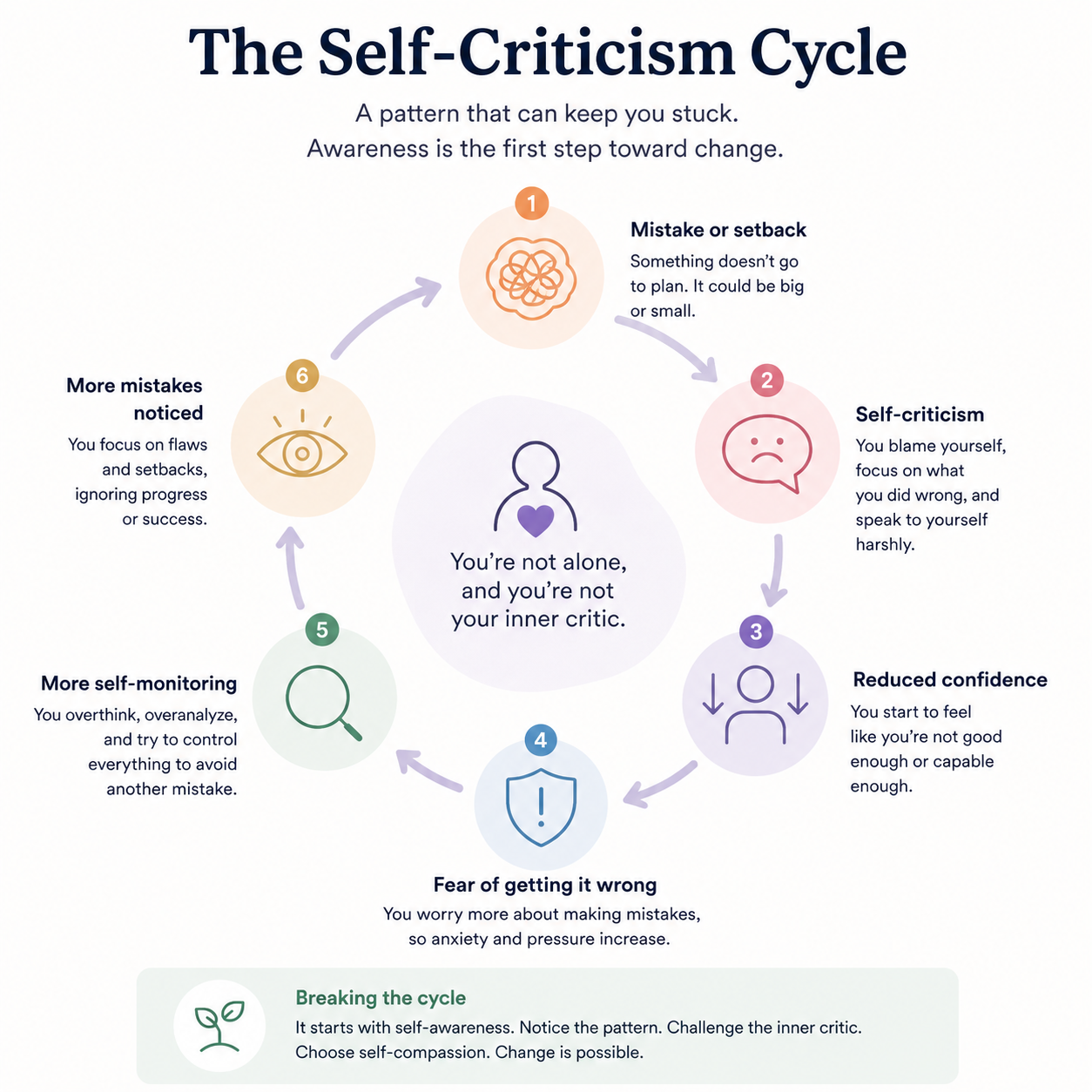
The cycle
This can create a difficult cycle.
The more critical a person becomes of themselves, the more attention they pay to their perceived shortcomings. The more attention they pay to those shortcomings, the more evidence they believe they have that they are not good enough.
Over time, confidence can begin to erode.
Belief
Many people assume that being hard on themselves helps them achieve more.
Reason
They may believe self-criticism keeps them motivated, prevents complacency, or pushes them towards success.
Reality
In reality, the relationship can be more complicated.
Short-term vs long-term
Self-criticism may sometimes create short-term motivation.
While self-criticism may sometimes create short-term motivation, it can also increase stress, undermine confidence, and make it harder to recover from setbacks.
Instead of encouraging growth, it may leave people feeling as though nothing they do is ever quite enough.
When achievements do not land
For some people, achievements can be difficult to hold on to.
Success may be minimised, explained away, or quickly replaced by a focus on the next goal, mistake, or perceived shortcoming.
Over time, this can become exhausting.
A gentler standard
Being kinder to yourself does not mean lowering your standards or pretending mistakes do not matter.
A different way forward
It can mean recognising that growth and self-respect are not opposites, and that people often learn more effectively through encouragement than criticism.
A useful question
"Would I speak to somebody I care about in the same way I speak to myself?"
A useful question may not be:
"Why am I not good enough?"
but:
"Would I speak to somebody I care about in the same way I speak to myself?"
For many people, the answer is no.
That realisation can be the beginning of a very different relationship with themselves.
Browse Therapists
If you would like to explore therapy, you can browse verified therapists on Mindtend and choose someone who feels right for you.
Browse Therapists