
Some memories feel different
Sometimes it is a positive memory.
Sometimes it is a positive memory. A conversation, achievement, or moment that still brings warmth when it comes to mind.
Other experiences can have a different effect.
A particular comment may still sting years later. A difficult relationship may continue to influence how safe it feels to trust other people. An upsetting experience may still trigger a strong emotional reaction long after the event itself has ended.
This can be confusing.
People often tell themselves that they should be over it by now. They may wonder why something that happened months or years ago still seems to affect them in the present.
The reality is that experiences do not always disappear simply because time has passed.
A different way to see it
That does not mean something is wrong.
Lasting impressions
Some experiences can leave a lasting impression.
Some experiences can leave a lasting impression on the way we think, feel, relate to others, and respond to the world around us.
That does not mean something is wrong.
It may simply mean that the experience was more significant than it first appeared.
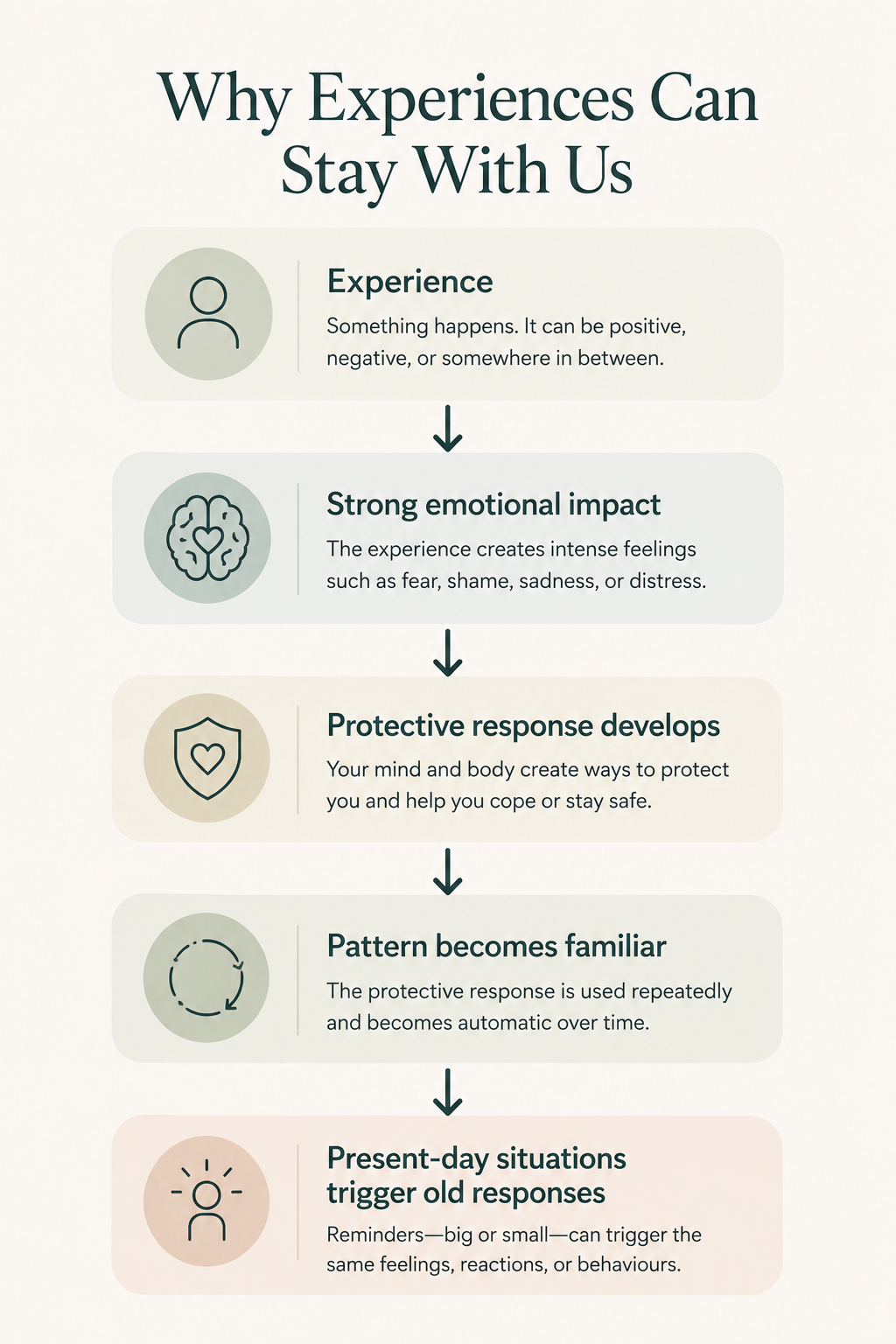
How patterns can form
Not all experiences affect people in the same way.
An event that one person finds manageable may feel overwhelming to someone else. Factors such as age, support networks, previous life experiences, personal circumstances, and the nature of the event itself can all influence how an experience is processed.
For some people, difficult experiences can lead to protective responses.
Reason
These responses often develop for a reason.
Purpose
They may help a person cope, stay safe, avoid further harm, or make sense of what has happened.
Over time
Over time, however, some of these responses can become so familiar that they continue long after the original situation has passed.
Past and present
This is one reason the past can sometimes appear to show up in the present.
A person may find it difficult to trust others without fully understanding why. Certain situations may trigger a strong emotional response. Some people may avoid particular places, conversations, or experiences because they create a feeling of discomfort or unease.
These reactions can be frustrating, particularly when there appears to be no obvious reason for them.
Yet the mind and body do not always respond to what is happening now. Sometimes they can also respond to what has happened before.
This is why "getting over it" is often more complicated than people imagine.
Healing is rarely about forgetting the past or pretending it did not happen. For many people, it involves understanding the impact an experience has had, recognising patterns that may have developed over time, and finding ways to move forward without the past continuing to shape every part of the present.
There is no set timeline for this process.
People respond to experiences differently, and healing can look different from one person to the next.
Time is not the only measure
What matters is not how long ago something happened.
What matters
What matters is whether it is still affecting your life today.
Browse Therapists
If you would like to explore therapy, you can browse verified therapists on Mindtend and choose someone who feels right for you.
Browse Therapists