
At night
When the distractions disappear
You replay conversations. Think about things you should have said differently. Worry about tomorrow. Remember something embarrassing from years ago. Jump from one thought to the next.
The harder you try to switch off, the busier your mind seems to become.
If this sounds familiar, you're not alone.
Problem solving
Many people assume that constant thinking means something is wrong with them.
Preparing
In reality, the mind is often trying to do exactly what it was designed to do: solve problems, predict threats, and prepare for what might happen next.
The difficulty
The difficulty is that the brain doesn't always know when to stop.
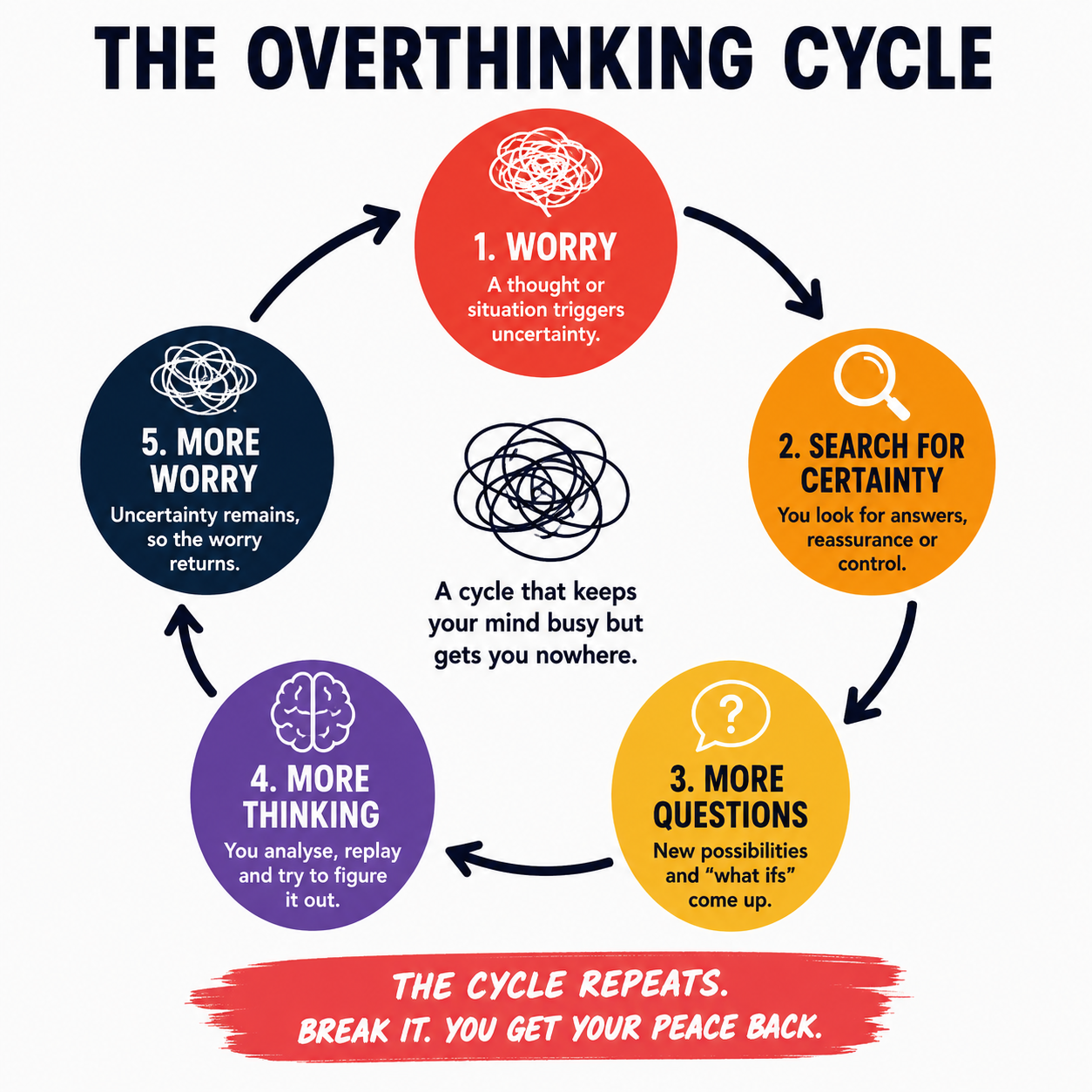
A thought appears.
"What if I made a mistake?"
The mind starts searching for answers.
That leads to another question.
Then another.
Before long, what started as a single thought has become a chain of worries, possibilities, and imagined scenarios.
Certainty
Most of the time, overthinking begins with a genuine attempt to gain certainty.
The mind believes that if it thinks about something for long enough, it will eventually arrive at an answer that feels safe.
The problem is that many of life's biggest questions don't have perfect answers.
As a result, the mind keeps searching long after the search has stopped being helpful.
This is one reason overthinking often feels productive while simultaneously leaving people feeling exhausted. A lot of mental energy is being used, but very little is being resolved.
Why night feels louder
The mind finally has space.
Many people notice this most at night.
During the day there are distractions, conversations, responsibilities, and things demanding attention. At night, those distractions disappear.
The mind finally has space.
Unfortunately, that space is often filled with unfinished worries, unanswered questions, and concerns that have been waiting patiently in the background all day.
If you regularly find yourself caught in these cycles, it does not necessarily mean you are doing anything wrong.
Sometimes the most helpful question is not:
"How do I stop thinking?"
but:
"Why does my mind feel it needs to keep thinking?"
Understanding what sits underneath persistent worry or overthinking can often be more useful than trying to force thoughts away.
Browse Therapists
If you would like to explore therapy, you can browse verified therapists on Mindtend and choose someone who feels right for you.
Browse Therapists